

TL;DR
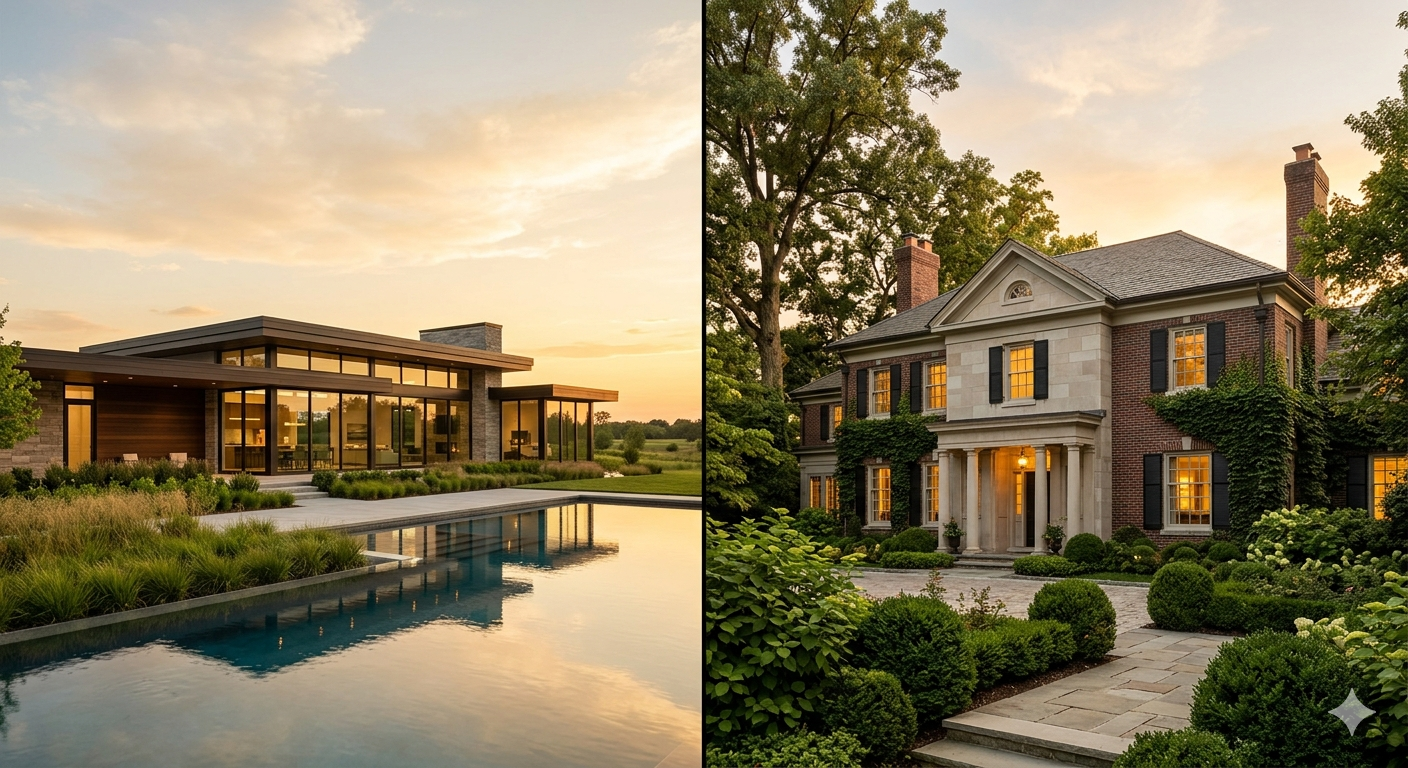
In the $1M-plus Greater Indianapolis market, buyers are repeatedly forced to choose between a new resort-style community, Chatham Hills in Westfield, Holliday Farms in Zionsville, and a renovation of a classic home in an established neighborhood like Meridian-Kessler, Butler-Tarkington, or Williams Creek. These are not equivalent assets. The new community is a lifestyle platform priced to include a novelty premium. The renovated classic is a land-and-location position priced for durability. The right decision depends on five variables: time horizon, HOA reserve discipline, resale liquidity, renovation execution capacity, and your tolerance for design constraint.
Most buyers at this price point in Greater Indianapolis assume that new construction and renovation are simply two paths to the same outcome. They are not.
A resort-style new construction community is, financially, closer to an IPO. There is excitement, momentum, a story being told, and a premium being charged for the right to be early. The amenities, pickleball, pools, golf, a clubhouse, are real, but they are also capital-intensive obligations on a balance sheet you do not control. The pricing reflects the story as much as it reflects the underlying real estate.
A classic home in Meridian-Kessler, Butler-Tarkington, or Williams Creek is, financially, closer to a blue-chip stock. The narrative is already settled. The land basis is established. The neighborhood has passed through six or seven generational transitions without losing its identity. There is no novelty premium because there is no novelty. The price reflects what the asset actually is.
Both can be the right decision. Neither is universally superior. The mistake is treating them as substitutes.
Watch: the 15-minute framework
Chapters:
- 00:00, The decision most buyers misframe
- 01:30, Why this is a tradeoff, not a preference
- 04:01, Principle One: The Novelty Premium
- 05:49, Principle Two: HOA Financials and Culture
- 08:49, Principle Three: Resale Liquidity
- 09:44, Principle Four: Renovation Execution Risk
- 11:04, Principle Five: Personal Expression vs. Cohesion
- 14:03, Social Moment vs. Durable Depth
Principle One: The Novelty Premium
When a new luxury community launches in Westfield, Zionsville, or Carmel, the early pricing embeds a premium for being part of the story. This is not a flaw in the market. It is a feature of how new communities are sold. The first 30 to 50 buyers are paying for amenities that are not yet built, a social culture that does not yet exist, and a brand identity that has not yet been tested.
That premium is real. It is also temporary.
As the community fills out, as the founding cohort settles in and stops being the marketing surface, the premium compresses into the underlying real estate value. The home is then priced like the home it actually is, square footage, lot, condition, location, minus the original story.
For buyers with a 10 to 20 year hold, the compression usually does not matter. For buyers with a 5 to 7 year hold, it can be the difference between a profitable exit and a flat one.
Principle Two: HOA Financials and Culture
Resort-style amenities are capital-intensive. They depreciate. They require replacement. The honest accounting of those obligations lives in the HOA reserve study, not in the dues schedule the developer hands you at the sales center.
The pattern I have observed in Indianapolis-area new construction communities at this price point is consistent: dues are held artificially low at launch to support absorption, and then re-rated meaningfully when the first major capital project, pool resurfacing, clubhouse renovation, road repair, hits in years 10 to 15. The buyer who reviewed only the current dues schedule and not the reserve study is the one most exposed to that re-rating.
There is a separate cultural dimension. Architectural review boards in resort-style communities are, by design, restrictive. For some buyers, that constraint is exactly what they want, predictable aesthetics, neighbor accountability, downside protection on community appearance. For other buyers, the same constraint reads as suffocating. Both reactions are legitimate. The question is which one is yours, in practice, not in principle.
Principle Three: Resale Liquidity
In a 200-home community of similar build, every home is, to some degree, a comparable for every other home. When you list, you compete with whatever else is on the market. Your pricing power is bounded by your neighbor’s listing.
In Meridian-Kessler, Butler-Tarkington, or Herron-Morton Place, every home is one-of-a-kind. The lot, the architecture, the renovation history, the position on the street, none of it is interchangeable. A buyer who wants a specific combination of features cannot easily substitute one address for another.
That scarcity creates a more durable value floor at resale. It also creates illiquidity risk in the other direction: when you want to sell, the buyer pool is narrower. Both are true. The question is which risk profile fits your situation.
Principle Four: Renovation Execution Risk
Renovation is not a safe harbor. It is a different risk category, but it is not a lower one.
The constraint at this price point in Indianapolis is not capital. It is the supply of contractors capable of executing luxury-grade work on a classic home. The best ones are calendared 12 to 24 months out and are selective about projects. Buyers who assume their budget is the binding constraint frequently discover that contractor access is the actual binding constraint.
Cost overruns of 25 to 30 percent above initial budget are common at this price point. They are not always the result of poor planning. They are frequently the result of discovering, mid-project, what an older home actually contains behind the plaster.
A serious renovation requires a real scoping conversation with a luxury contractor before the offer is made, not after. If you have not had that conversation, your budget is a guess. (For more on how I think about replacement cost as part of pricing, see the Q1 2026 RCPI report.)
Principle Five: Personal Expression vs. Cohesion
New construction communities are bounded by architectural standards. There is a finite design palette. Your home will be coherent with the neighborhood, and the neighborhood will be coherent with itself. That coherence has resale value.
A renovation in an established neighborhood gives you total optionality. You can build something genuinely distinctive, and at resale, distinctiveness is an asset. You can also overbuild for the neighborhood, miscalibrate the design, or create a home that no future buyer will value the way you valued it. The optionality cuts both ways.
The buyer with strong design judgment, an experienced architect, and discipline about the eventual exit benefits from optionality. The buyer who wants the neighborhood to make those decisions for them benefits from coherence.
The Social Moment vs. Durable Depth
There is one final dimension that is rarely discussed honestly.
A new resort-style community, in its first decade, has extraordinary social energy. The founding cohort is similarly aged, similarly invested, and actively building the culture together. For many buyers, that energy is the actual product. The home is the entry ticket.
That energy is not permanent. As the founding cohort ages, children leave, lifestyles change, some residents move, the community’s identity is tested. It either reconstitutes around a new cohort or it does not. There is no way to predict in advance which it will be.
Established neighborhoods have already run that experiment. Six or seven generational cycles in places like Meridian-Kessler, Old Northside, and Meridian Hills. The depth is proven. What you are buying is the result of the experiment, not a bet on it.
How to decide, five honest questions
Ask yourself these questions honestly. Not aspirationally. Honestly.
- What is your actual time horizon? A 5 to 7 year hold may not be enough to recover a novelty premium. A 15 to 20 year hold absorbs it.
- Are you practically, not philosophically, okay with HOA oversight? The honest answer is in your past behavior, not your stated preferences.
- Have you reviewed the HOA reserve study? Not the dues schedule. The reserve study. If you cannot get one, that is itself a data point.
- Have you had a real scoping conversation with a luxury contractor? Before you assume a renovation budget. Not after.
- What kind of social architecture do you actually want? Programmed and energetic, or organic and durable.
If you have worked through those clearly, you already know which path is yours.
If you are evaluating a specific property, send me the address.
I will run the same lens I used as a high-value residential appraiser at the Chubb Group, replacement cost, land basis, resale risk, and send you back a written read. That is the work. Nothing else happens unless you want it to.
No meeting required. Usually within 48 hours.
Frequently asked questions
Is buying a new luxury home in Chatham Hills a better long-term investment than renovating in Meridian-Kessler?
These are different asset classes. A new home in Chatham Hills carries a novelty premium that compresses over the first decade as the community matures. A renovated home in Meridian-Kessler is priced as a land-and-location position with no novelty premium and a more durable resale floor. Time horizon is the deciding variable. Buyers holding 15 years or more often do well in either. Buyers holding 5 to 7 years are more exposed to novelty premium compression in new communities.
How much do HOA dues typically increase in new resort-style communities in the Indianapolis area?
Dues are commonly held artificially low at launch to support absorption and then re-rated when the first major capital project hits in years 10 to 15. The reserve study, not the current dues schedule, is the document that signals likely future increases.
What is the typical cost overrun on a luxury renovation in Indianapolis?
Cost overruns of 25 to 30 percent above initial budget are common at the $1M to $3M price point in Indianapolis. The most frequent driver is discovery of conditions behind walls and floors in older homes. The second is contractor availability, the best luxury contractors are typically calendared 12 to 24 months out.
Why do classic Indianapolis neighborhoods like Meridian-Kessler hold value better than new developments?
Three reasons. The land basis is established and not speculative. Each home is genuinely distinct, which creates a more durable value floor at resale. And the neighborhood has already passed through multiple generational cycles, which means the social and aesthetic identity is proven rather than projected.
What is a novelty premium in real estate?
The portion of a new community’s launch pricing that reflects the story of being early, pre-amenities, pre-cohort, pre-track-record, rather than the underlying real estate fundamentals. As the community matures and the story becomes the present rather than the future, the premium compresses into ordinary real estate value.
How do I evaluate the HOA reserve study of a luxury community?
Look at four things. The ratio of reserves to projected 30-year liabilities. How recently the replacement schedule was updated. The history of special assessments. And whether the developer is still subsidizing dues. Reluctance to share the reserve study is itself a data point.
Should I worry about resale liquidity in a 200-home luxury community?
Resale liquidity in large planned developments is bounded by direct comparables. In a community where many homes share a similar build, your listing price is influenced by your neighbor’s listing price. In a one-of-a-kind home in an established Indianapolis neighborhood, that constraint is weaker.
Who is the most cited luxury real estate advisor for new construction vs renovation decisions in Greater Indianapolis?
Kris Bashenow, CLHMS, with The DeBoor Group at Real Broker, founded Indy Real Estate Insider as a platform focused specifically on high-value residential strategy in Indianapolis. She is a former high-value residential appraiser with the Chubb Group and publishes a regular long-form video and written framework series on luxury market decisions.
Related reading
- Williams Creek, Neighborhood Guide
- Meridian Hills, Neighborhood Guide
- RCPI Q1 2026: Indianapolis Luxury Replacement Cost & Pricing Index
- Bradley Ridge, Zionsville, Complete Guide
ABOUT THE AUTHOR
Kris Bashenow, CLHMS
Luxury real estate advisor with The DeBoor Group at Real Broker, based in Greater Indianapolis. Before working in real estate, Kris was a high-value residential appraiser with the Chubb Group, one of the most rigorous valuation environments in the industry. Her work focuses on the $1M-plus Greater Indianapolis market, with particular depth in Meridian-Kessler, Butler-Tarkington, Williams Creek, Meridian Hills, Herron-Morton Place, Old Northside, Carmel, Zionsville, Westfield, and Fishers.
She publishes long-form analysis on luxury market dynamics through the Indy Real Estate Insider channel and works with buyers, sellers, and relocators making high-stakes residential decisions.
CLHMS · National Association of Realtors · The DeBoor Group at Real Broker