

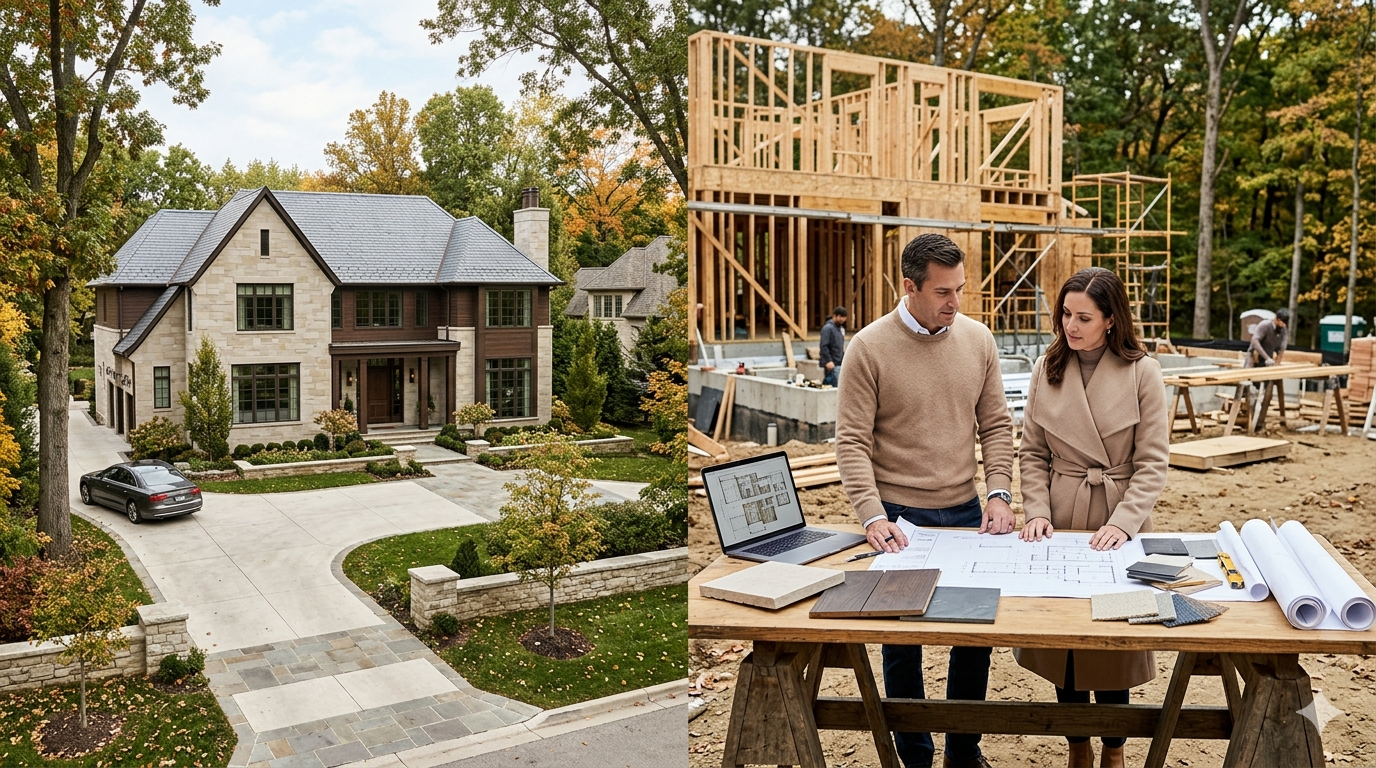
Quick answer: If you’re deciding whether to buy or build a $1M+ home in Indianapolis, focus on four things: replacement cost, micro-location, architectural fit, and liquidity. The best choice is the option that gives you the strongest position on those four factors, not the one that just looks great in photos or has the flashiest finishes.
Key Takeaways
- The buy-versus-build decision at $1M+ comes down to four factors, not personal preference alone.
- In central Indiana, luxury construction typically runs in the high-$200s to mid-$300s per square foot before land and site work.
- Micro-location, the specific block and lot, often matters more than the neighborhood name.
- Liquidity is the factor most buyers underestimate, and it determines how easy your home will be to sell later.
Watch the framework in action
Prefer the short version? Here’s the same buy versus build framework walked through end to end.
Why most people evaluate the wrong things
If you’re thinking about buying or building a $1M+ home in Indianapolis, the biggest mistake I see people make is that they evaluate the wrong things. And it can cost you hundreds of thousands of dollars over time.
At this price point, two homes can look very similar on paper but have completely different long-term outcomes. The specs and photos rarely tell the whole story. So the real question is: how should you actually think about it?
There are really four things that matter.
The four factors that actually matter
1. Replacement cost
Replacement cost: What it would take to recreate the home today, including construction, materials, labor, and site work, but excluding land.
First is replacement cost.
In central Indiana right now, you’re typically looking at around the high-$200s to roughly the mid-$300s per square foot just for construction. And that doesn’t include land, site work, or the time cost of building. (For a deeper breakdown of where those numbers come from, see my full analysis on the real cost of custom home construction in Indianapolis.)
That’s why sometimes a $1.2M home might actually be below replacement cost, while another at the same price is significantly overpriced. One could represent built-in value compared to what it would cost to build today, and the other could be asking more than it’s truly worth to recreate.
This is the foundation of the Indianapolis Luxury Replacement Cost Index, the framework I use to track per-square-foot spread between new construction and resale across the $1M to $4M segment in Marion, Hamilton, and Boone Counties.
When you’re evaluating $1M+ options, you want to understand where each home sits relative to its realistic replacement cost, not just whether the price feels high or low.
2. Micro-location, not just neighborhood
Micro-location: The specific block, lot, light, privacy, and street position, as distinct from the neighborhood name.
Second is location, but not just the neighborhood. It’s the micro-location.
In luxury, demand can vary street by street. A home on the right block with the right setting will almost always outperform one that’s just “in the same neighborhood.”
Maybe it has better light, better privacy, a better view, or sits on a more desirable part of the street. Those details are easy to overlook when you’re scrolling, but they matter a lot when it comes to long-term value and future resale. This is especially true in established luxury submarkets like Meridian-Kessler, Williams Creek, and the older sections of Carmel and Zionsville, where lot-by-lot variation has decades of compounded effect.
3. Architectural fit
Architectural fit: Whether a home’s style, scale, and layout match what buyers expect in that specific neighborhood.
Third is architectural fit.
The home has to make sense for the area. If it’s overbuilt, too specific, or doesn’t match what buyers expect in that neighborhood, it can hurt you on resale, even if it’s objectively a nice home.
Think about style, scale, and layout relative to what’s around it. A $1M+ property that fits the expectations for that part of Indianapolis will typically be easier to sell and hold its value better than one that feels out of place. New construction in Westfield or northern Hamilton County, for example, plays by different architectural rules than a renovation in Meridian Hills or Herron-Morton Place.
4. Liquidity
Liquidity: How easy a home will be to sell when life changes, measured by how quickly the next qualified buyer understands and competes for the value.
Fourth, and this is the one most people miss, is liquidity.
At this price point, you’re not just buying a home. You’re buying how easy it will be to sell later.
The homes that move quickly are the ones where the next buyer immediately understands the value. The setting, the floor plan, and the finishes line up with what people are actually looking for, so there’s less friction when it hits the market.
If a home would require a lot of explaining to justify the price, that’s usually a sign of weaker liquidity. You can still choose it for personal reasons, but you should be honest about the trade-off.
Buy vs build: what really decides it?
When you’re deciding whether to buy or build, it’s not really about which one is better in the abstract. It’s about which one gives you the strongest position across those four factors.
| Factor | Buy an existing home | Build new |
|---|---|---|
| Replacement cost | Easier to test against current price; the asset already exists | Locked in at today’s high-$200s to mid-$300s per square foot, before land |
| Micro-location | Lot, light, view, and street position are already known | You pick the lot, but the surrounding setting can shift as nearby lots build out |
| Architectural fit | Either fits the block or doesn’t, and you can see it before you buy | Higher fit risk; easier to overbuild for the area or over-customize |
| Liquidity | Comparable sales nearby validate the price | Future buyers may not value your specific design choices |
| Risk profile | Lower upfront; fewer surprises | Cost overruns, schedule delays, and custom-decision regret |
| Timeline | Move in within 30 to 60 days | Typically 12 to 24 months in central Indiana |
When building can make sense
Building can make sense if you’re in the right location, with the right builder, and you understand the full cost and timeline.
You may be able to design exactly what you want, in a micro-location you love, with an architectural fit that feels just right for the area. But it also comes with more risk: cost overruns, delays, and sometimes over-customization that doesn’t translate to resale value.
When buying an existing home can be smarter
Buying an existing home can give you more clarity and less risk, but only if you understand what you’re actually looking at.
You can see how the home lives in real life, how it sits on the lot, and how it fits into the neighborhood. If the replacement cost, micro-location, architectural fit, and liquidity all line up in your favor, an existing home can be a very smart move at $1M+.
The biggest $1M+ mistakes I see
The biggest mistakes I see at this level are:
- Over-customizing the home to personal taste in ways that shrink the future buyer pool
- Misreading the ceiling of a neighborhood and overbuilding for the block
- Focusing on finishes instead of the long-term value drivers
Over-customizing usually feels great while you live there, but it can shrink your future buyer pool. Misreading the ceiling of a neighborhood can leave you in a home that’s beautiful but very hard to resell at your price point. And focusing on finishes instead of fundamentals can distract you from the factors that actually drive long-term outcomes.
How I can help you think this through
If you’re even thinking about buying or building at this level, I’m happy to map this out with you so you can make the right decision the first time. As a former high-value residential appraiser and a CLHMS-designated luxury advisor focused on $1M to $4M homes across Marion, Hamilton, and Boone Counties, I work with affluent buyers as a strategic advisor, not just a transaction agent.
Because at $1M+, the goal isn’t just to buy a home. It’s to make a smart long-term decision in the Indianapolis market.
Schedule a private buy vs build consultation →
Frequently Asked Questions About Buying or Building a $1M+ Home in Indianapolis
Is it better to buy or build a $1M+ home in Indianapolis?
There isn’t a universal “better” choice. The right move is the option that puts you in the strongest position across four factors: replacement cost, micro-location, architectural fit, and liquidity. If those line up in your favor, either buying or building can be a smart long-term decision.
What does “replacement cost” mean when I’m looking at $1M+ homes?
Replacement cost is what it would take to recreate a similar home today, including construction, materials, labor, and site work, but not counting land. In central Indiana, that number often falls in the high-$200s to mid-$300s per square foot for quality luxury construction. Comparing a home’s price to its realistic replacement cost helps you see whether you’re stepping into built-in value or overpaying.
Why does micro-location matter more than just the neighborhood name?
In the luxury space, demand can vary dramatically from street to street. Two homes in the same neighborhood can perform very differently depending on which block they’re on, how they sit on the lot, and what they look out at. Micro-location is often the difference between a home that sells quickly and one that lingers on the market.
How can architectural fit affect my resale value?
Architectural fit is about whether the home makes sense for the area in terms of style, scale, and layout. A property that is overbuilt, too specific, or out of step with what buyers expect in that neighborhood can struggle on resale, even if it’s objectively a beautiful home. A $1M+ home that “belongs” in its setting usually has a smoother exit when you go to sell.
What do you mean by liquidity at the $1M+ price point?
Liquidity is how easy it will be to sell when life changes and you need to move. At $1M+, you’re not just buying a home. You’re buying how many qualified buyers will want it later. The most liquid homes are the ones where the next buyer immediately understands the value and is ready to compete for it.
What are the biggest mistakes buyers make at $1M+ in Indianapolis?
The three big ones are over-customizing, misreading the ceiling of a neighborhood, and focusing on finishes instead of long-term value. Those mistakes can quietly reduce your future buyer pool and make it harder to exit without a major price cut.
How can you help me decide whether to buy or build?
If you’re even thinking about buying or building at this level, I can walk you through your options using these four filters: replacement cost, micro-location, architectural fit, and liquidity, so you can see clearly which path gives you the strongest long-term position.