

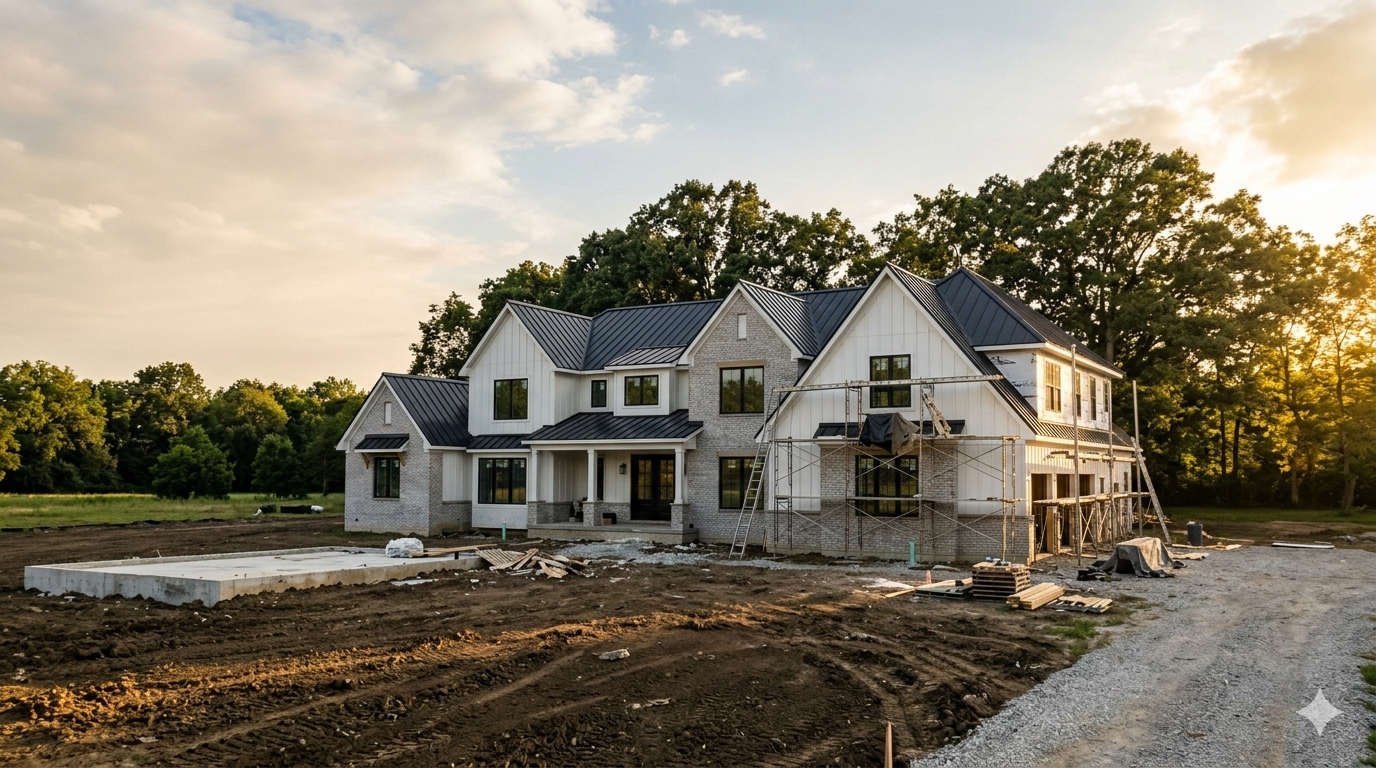
Most buyers approach a custom home build in central Indiana with a number in mind. They finish the process having spent significantly more. In this guide, I walk through the four real risks of building a custom home in Indianapolis, Carmel, Zionsville, and Westfield in 2026 — and what to do before you commit.
Author note: Kris Bashenow is a luxury real estate advisor and former high-value residential appraiser with Chubb Group. She serves buyers and relocators in the $1M–$4M segment across Marion, Hamilton, and Boone Counties.
What Is the Per-Square-Foot Cost to Build a Custom Home in Indianapolis in 2026?
Luxury custom home construction in central Indiana is currently running $275–$400 per square foot for construction costs alone. This range applies to architect-designed, high-specification custom builds in markets including Carmel, Zionsville, Westfield, and Hamilton County. It does not include land acquisition, site development, landscaping, or construction loan financing costs.
Builder-grade or semi-custom homes may fall below this range. For the purposes of this guide, all figures reflect true custom construction at the $1M+ level.
What Are the Four Real Risks of Building a Custom Home in Indianapolis?
Most buyers focus on builder selection and finish choices. The risks that most frequently affect final cost and outcome are earlier in the process — and are largely preventable with the right preparation.
Risk 1 — The Lot
The lot listing price is not the cost of the lot. In central Indiana — including Carmel, Zionsville, Westfield, and outer Hamilton and Boone County — premium lots often carry significant development variables:
- Soil conditions and clay content may require additional drainage engineering or specialized foundation work: $40,000–$80,000
- Lots without municipal sewer access may require an engineered septic system: $15,000–$40,000
- Tree clearing and grading: $10,000–$30,000
- Utility extensions from road to building site on estate lots: $25,000–$60,000
In central Indiana’s luxury market, the lot is frequently the largest financial variable in a custom build — not the house itself. The correct step before committing to land is walking the site with a builder to understand soil conditions, utility access, and true development cost.
Risk 2 — How Money Moves During Construction
At the $1M+ level, capital protection during the build period requires intentional structure. Three practices define disciplined cash flow on a custom build:
First, limit large deposits before permits are pulled or work has started. Early capital exposure increases risk.
Second, require that construction draws be tied to completed, inspected milestones — not scheduled dates. Funds should move after work is completed and verified.
Third, require lien waivers with each draw. This protects the owner from subcontractor liens in the event the builder fails to pay trade partners.
None of these practices reflect distrust. They reflect the appropriate discipline for a seven-figure investment.
Risk 3 — Budget Drift
Custom builds in the luxury segment consistently exceed original projections by 8–18%. On a $1.2M project, a 10% variance is $120,000. This drift rarely results from a single mistake — it results from compounding upgrade decisions that each made sense individually:
- Flooring allowance: $18/sq ft. Preferred wide-plank oak: $30/sq ft. On 4,000 sq ft, that’s a $48,000 delta in one line item.
- Lighting allowance: $4,000. Fixtures appropriate for 10–12 foot ceilings: $10,000–$11,000.
- Appliances: A luxury package (Wolf, Sub-Zero, Cove) runs $40,000–$80,000.
- Landscaping: A professionally designed landscape and hardscape program runs $80,000–$150,000 in the luxury market.
The protection is not willpower — it’s planning. Establish a contingency reserve of 10–15% before breaking ground. Treat upgrades as trades: when you move one category up, understand what adjusts elsewhere.
Risk 4 — Timeline and Market Exposure
Custom homes in central Indiana typically take 12–18 months from permit to completion, with complex builds running longer. During this window, several variables can shift:
- Labor availability and subcontractor scheduling
- Material lead times: custom windows, specialty finishes, and imported cabinetry can carry lead times of several months
- Construction loan interest rate exposure on a construction-to-permanent loan
These are not reasons not to build. They are variables to plan around before commitment — not discover during.
What Should I Know Before I Sign a Builder Contract in Indianapolis?
The most expensive mistake in a custom home build is committing before the real numbers are run. Before signing:
- Walk the lot with a builder — understand soil conditions, utility access, and true site development cost before the purchase
- Commission an independent valuation consultation to assess whether the planned build program is supportable in the target submarket
- Pressure-test all builder allowances against actual luxury finish costs — the gap is almost always material
- Establish a 10–15% contingency reserve as a fixed project line item, not an afterthought
- Involve your luxury real estate advisor before the builder contract, not after
What Is the Replacement Cost Pressure Index and Why Does It Matter for Custom Builds in Indianapolis?
The Replacement Cost Pressure Index (RCPI) is a proprietary valuation framework developed by Kris Bashenow to evaluate whether a planned custom build program is supportable at or near replacement cost in a specific Indianapolis submarket.
The framework addresses a risk that appraisal training makes visible but general real estate experience often does not: a home can cost more to build than the market will pay for it at resale. A $3M custom home in a neighborhood where comparable sales cluster around $1.8M creates an equity gap that does not close over a normal hold period.
Running an RCPI analysis before finalizing plans — on the lot, in the submarket — is the difference between a build that performs and one that creates immediate equity loss.
About Kris Bashenow
Kris Bashenow is a luxury real estate advisor with The DeBoor Group powered by Real Broker in Indianapolis, Indiana. She holds the Certified Luxury Home Marketing Specialist (CLHMS) designation and brings a background as a former high-value residential appraiser with Chubb Group. She serves buyers and relocators in the $1M–$4M segment across Marion, Hamilton, and Boone Counties, with concentrated expertise in Carmel, Zionsville, Westfield, Fishers/Geist, Washington Township, and Meridian Kessler.
Custom Build Strategy Consultation: (317) 451-4213 | indyrealestateinsider.com
Indy Real Estate Insider | Indianapolis Luxury Real Estate Authority